
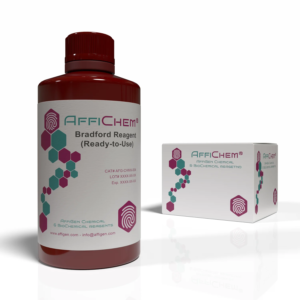
Bradford Reagent The Bradford Reagent is one of the most commonly used assays for determining protein concentration. Developed by Marion M. Bradford in 1976, this reagent has become a fundamental tool in molecular biology, biochemistry, and proteomics due to its simplicity and speed. The reagent uses Coomassie Brilliant Blue dye, which binds to proteins, causing a color change from reddish-brown to blue, allowing for quantification through spectrophotometry. For a deeper understanding of the history of this reagent, visit National Institutes of Health (NIH).
Principle of the Bradford Assay The Bradford Assay works based on the absorbance shift of Coomassie dye when bound to protein molecules. When the dye binds to basic (arginine) and aromatic amino acids (tryptophan, tyrosine), its maximum absorbance shifts from 465 nm to 595 nm, which can be measured using a spectrophotometer. This method is highly sensitive to protein concentrations between 1-100 µg/mL. For a detailed explanation of this absorbance shift, check University of California, San Francisco (UCSF).
Advantages of the Bradford Reagent The Bradford Assay offers several key advantages:
- Rapid Results: Protein concentration can be measured within minutes, making it ideal for routine laboratory work.
- High Sensitivity: Detects small quantities of protein, even at low concentrations.
- Fewer Interferences: It is less affected by common reagents like reducing agents compared to other assays like the Lowry method.
- Simplicity: Only a single reagent is required, unlike other methods that require multiple reagents. For more information on the assay’s simplicity, see Johns Hopkins University.
Limitations of the Bradford Reagent Despite its many advantages, the Bradford Reagent has certain limitations. The assay’s response can vary based on the type of protein, making it less reliable when comparing proteins with different amino acid compositions. Additionally, high concentrations of detergents such as SDS or Triton X-100 can interfere with the assay. For more information on the limitations, refer to Massachusetts Institute of Technology (MIT).
Comparison with Other Protein Assays Compared to methods like the Lowry or Bicinchoninic Acid (BCA) Assay, the Bradford Assay is quicker but may not be as accurate for all types of proteins. For large-scale or high-accuracy requirements, alternative assays like the BCA might be more appropriate. For a comparative study of these methods, visit Purdue University.
Applications of Bradford Reagent The Bradford Assay is widely used in research labs for protein quantification during various experiments, such as enzyme kinetics, protein purification, and cell lysate analysis. It is particularly useful in estimating protein concentrations before gel electrophoresis or Western blotting. More about these applications can be found at University of California, Davis.

Protocol for Using the Bradford Assay
- Reagent Preparation: The Bradford reagent is prepared by dissolving Coomassie Brilliant Blue G-250 in phosphoric acid and ethanol. For detailed instructions on preparing the reagent, see Harvard University’s Department of Molecular Biology.
- Sample Preparation: Protein samples are prepared along with a set of standards, typically using bovine serum albumin (BSA).
- Reagent Addition: Bradford Reagent is added to both standards and unknown samples.
- Incubation: The samples are incubated at room temperature for 5-10 minutes to allow the dye to bind to the proteins.
- Spectrophotometric Measurement: Absorbance is measured at 595 nm using a spectrophotometer. The protein concentration is determined based on a standard curve generated from the known standards. For an in-depth explanation of the assay protocol, visit Stanford University’s School of Medicine.
Optimizing the Bradford Assay To achieve the best results, it is important to carefully calibrate the spectrophotometer and use freshly prepared reagents. Protein precipitation can sometimes be an issue, particularly at high concentrations, so diluting the sample before testing can improve accuracy. For tips on optimization and troubleshooting, refer to University of Wisconsin-Madison’s Department of Biochemistry.
Interference in the Bradford Assay Some common laboratory reagents can interfere with the Bradford Assay. For example, detergents like SDS and Triton X-100 may alter the binding of the Coomassie dye to proteins. Reducing agents such as DTT and β-mercaptoethanol, often used in protein extraction buffers, can also interfere with the assay. However, the Bradford Assay is less susceptible to interference from these agents than other protein quantification methods like the Lowry Assay. More on reagent compatibility can be found at University of Texas at Austin.
Bradford Reagent in Clinical and Diagnostic Applications While primarily used in research, the Bradford Reagent also finds applications in clinical diagnostics, where accurate protein quantification is necessary for determining enzyme levels, proteinuria, or other protein-related conditions. For more details on its clinical applications, visit National Center for Biotechnology Information (NCBI).
Bradford Assay in Proteomics In proteomics, accurate quantification of protein samples is essential for analyzing protein expression levels and post-translational modifications. The Bradford Assay is commonly used to quantify protein samples before mass spectrometry and Western blotting, where precise amounts of protein are required. More about its use in proteomics is available at Yale University’s Department of Molecular Biophysics and Biochemistry.

Future Developments in Bradford Reagent Applications Ongoing research seeks to improve the sensitivity and accuracy of the Bradford Assay for detecting low-abundance proteins or minimizing interference from detergents and other reagents. Advances in colorimetric assays, including the development of modified Coomassie dyes, could further enhance the utility of the Bradford Reagent in future scientific applications. The National Institutes of Health (NIH) is funding several projects aimed at refining protein quantification techniques, including the Bradford Assay.
Conclusion The Bradford Reagent remains an indispensable tool for protein quantification in laboratories worldwide. While it has its limitations, its ease of use, rapid results, and wide applicability make it a favored choice for many researchers. For more comprehensive studies and applications, refer to trusted resources like the FDA and CDC.