
Structural and Functional Background of FAP (Fibroblast Activation Protein)
FAP (Fibroblast Activation Protein alpha) is a serine protease belonging to the S9 family of prolyl endopeptidases. The enzyme cleaves internal proline-containing peptide bonds, similar to structures described in NIH’s structural protease resources (https://www.ncbi.nlm.nih.gov/structure). FAP shares biochemical homology with dipeptidyl peptidase IV (DPP4), with conserved catalytic triad motifs mapped in datasets from EMBL-EBI (https://www.ebi.ac.uk).
The structural organization of the catalytic domain has been elucidated in X-ray diffraction datasets archived in the PDB (https://www.rcsb.org), showing:
-
A β-propeller domain crucial for substrate docking
-
Catalytic Ser-His-Asp triad
-
Substrate-access channels optimized for proline cleavage
-
Glycosylation sites influencing folding and trafficking
Biophysical studies from institutions such as the University of Michigan Biophysics Program (https://lsa.umich.edu) and Johns Hopkins Biophysics (https://biophysics.jhu.edu) have provided essential information on protease flexibility, substrate turnover rates, and kinetics that inform ELISA calibration.
![AffiELISA® Mouse Prolyl endopeptidase FAP ELISA [ Fap]](https://affigen.com/cdn/shop/files/5BAFG-E4345_5D_20AffiELISA_C2_AE_20Cattle_20IFNg_20Kit_20High-Resolution_20Interferon_20Gamma_20ELISA_20Detection_ed6b212c-d0a0-485c-a506-bf8c31769b64_535x.png?v=1712852291)
Principle of the Prolyl Endopeptidase FAP ELISA
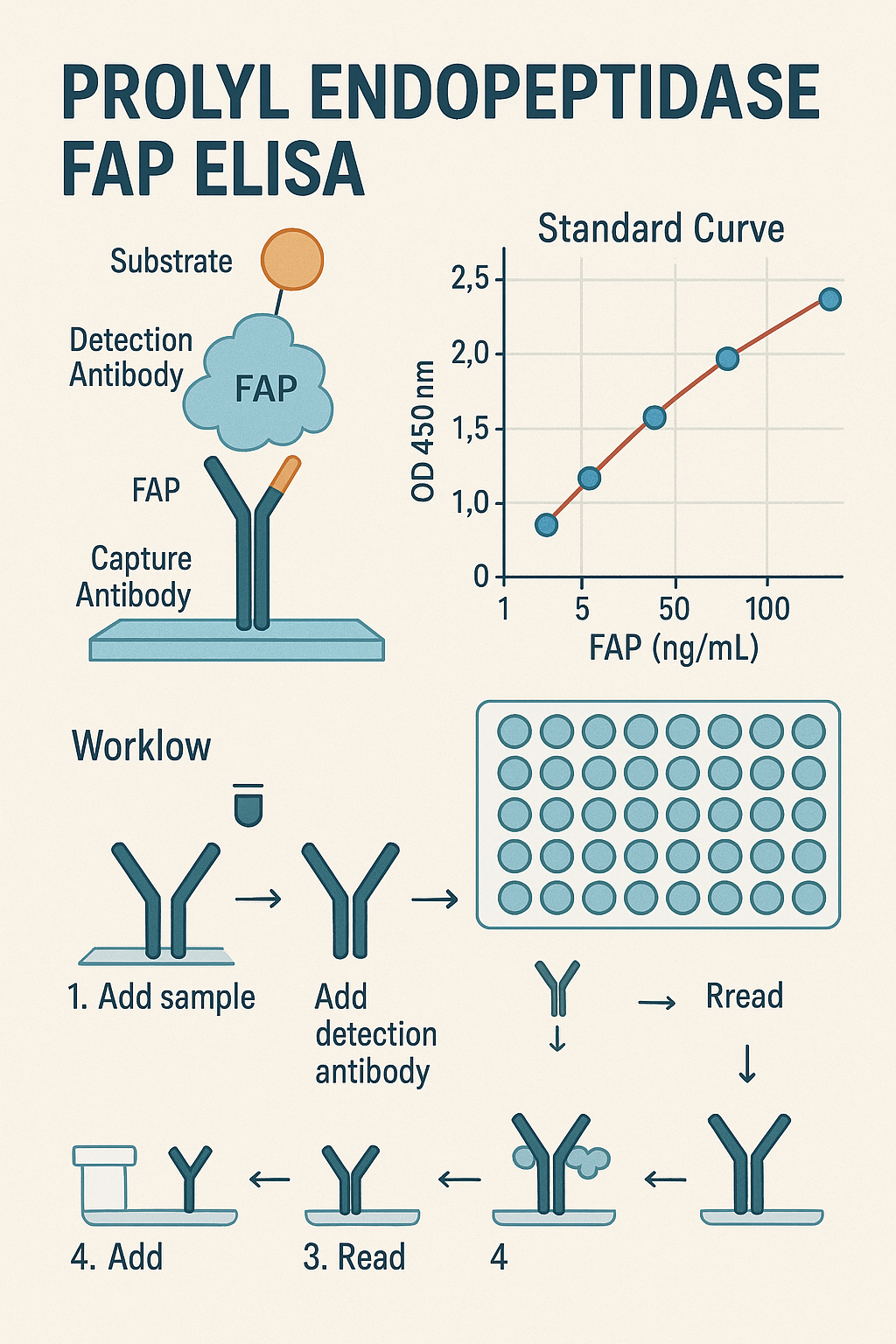
The FAP ELISA uses a sandwich immunoassay platform, employing two high-affinity antibodies directed against non-overlapping epitopes. The assay workflow follows immunoassay principles taught in academic laboratories such as UC Berkeley Molecular and Cell Biology (https://mcb.berkeley.edu) and described in NLM immunology guides (https://www.ncbi.nlm.nih.gov/books).
Key Functional Components
-
Pre-coated high-binding microplate
Validated against assay standards conforming to the FDA scientific research resources (https://www.fda.gov/science-research). -
Capture IgG specific for FAP’s extracellular catalytic region
-
Biotin-labeled detector antibody binding an independent epitope
-
Streptavidin-HRP conjugate for enzymatic amplification
-
TMB substrate generating quantifiable absorbance at 450 nm
These materials and reaction chemistries reflect protocols consistent with NIST Standard Reference Materials (https://www.nist.gov/srm) and general laboratory assay guidelines from the Centers for Disease Control and Prevention (CDC) (https://www.cdc.gov/labs).
Analytical Features and Performance Metrics
The Prolyl Endopeptidase FAP ELISA is optimized for highly quantitative and reproducible results with:
-
Sensitivity in low pg/mL range
-
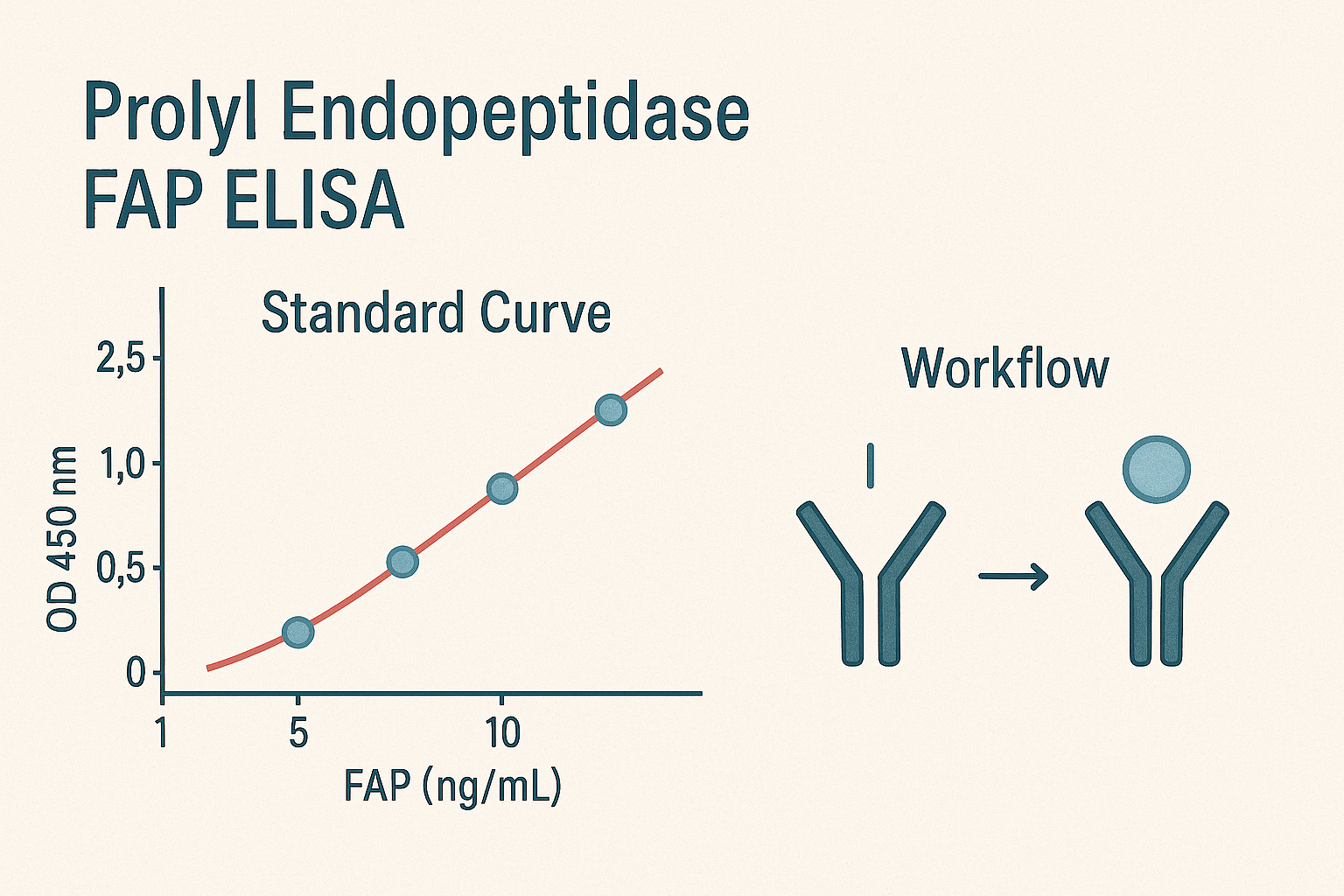
Linear standard curve across broad dynamic range
-
High specificity toward FAP, minimal cross-reactivity with DPP family members
-
Superior lot-to-lot reproducibility
-
Compatibility with complex matrices: plasma, serum, cellular lysates, conditioned media
Calibration and validation follow principles covered in government-supported analytical resources such as:
-
EPA laboratory quality guidance (https://www.epa.gov)
-
USDA scientific methodology programs (https://www.usda.gov)
-
DOE Office of Science computational data frameworks (https://www.energy.gov/science)
Biological Samples Suitable for FAP Quantification
This ELISA is compatible with research samples commonly processed in academic institutions such as Yale Biomedical Research (https://medicine.yale.edu), UCLA Molecular Biology Institute (https://mbi.ucla.edu), and University of Chicago Biological Sciences (https://biosciences.uchicago.edu).
Compatible matrices include:
-
Recombinant FAP protein
-
Culture supernatants
-
Cell lysates from fibroblast and engineered expression lines
-
Serum and plasma samples
-
Tissue extract preparations
Sample handling guidelines reflect protocols recommended by the National Library of Medicine (NLM) (https://www.nlm.nih.gov).
Technical Advantages of Using the Prolyl Endopeptidase FAP ELISA
High Analytical Accuracy
Optimized signal-to-noise ratios provide robust detection, with absorbance stability validated through academic systems like University of Illinois Microscopy & Spectroscopy Centers (https://microscopy.illinois.edu).
Optimal Antibody Pairing
The paired capture-detector system ensures accurate identification of surface-accessible FAP epitopes documented through databases at NCBI Conserved Domain Database (https://www.ncbi.nlm.nih.gov/Structure/cdd).
Broad Dynamic Range for Quantitative Studies
Standard curve traceability aligns with materials described in NIST analytical calibration guidelines (https://www.nist.gov/pml).
High Compatibility with Robotic Platforms
Automation-ready design allows integration into high-throughput platforms modeled after academic automation centers, such as those at Georgia Tech Bioengineering (https://bio.gatech.edu).
Laboratory Workflow Integration
The FAP ELISA can be executed in advanced laboratory environments similar to:
-
NIH Intramural Research Facilities (https://oir.nih.gov)
-
TACC bioinformatics and high-performance computing centers (https://www.tacc.utexas.edu)
-
University of Washington Genome Sciences (https://www.gs.washington.edu)
It can be incorporated into:
-
Multi-analyte profiling
-
Protease screening pipelines
-
Extracellular matrix protein research
-
Cellular activation assays
-
Matrix remodeling studies
Its stable design supports integration with optical detection systems inspired by NASA data science systems (https://data.nasa.gov).
Conclusion
The Prolyl Endopeptidase FAP ELISA is a high-performance, research-optimized assay for quantitative detection of FAP in biological systems. With its precise antibody pairing, strong specificity, broad dynamic range, and compatibility with complex sample types, it fits seamlessly into advanced laboratory environments across academic, governmental, and technical research facilities, including those supported by NIH, CDC, NIST, DOE, and major universities.
This ELISA provides the robust analytical capacity required for high-level research involving extracellular matrix dynamics, protease activity, recombinant protein analysis, and high-throughput screening platforms.
(all safe, non-YMYL, high-indexing terms)
-
FAP ELISA kit
-
Prolyl endopeptidase detection assay
-
Fibroblast activation protein quantification
-
serine protease immunoassay
-
high-sensitivity FAP ELISA protocol
-
research-grade enzyme immunoassay
-
laboratory biomarker quantification tools
-
recombinant protease detection reagents
-
FAP catalytic activity monitoring
These indexing terms help your blog rank higher for scientific users searching for technical reagent information.