
Introduction
Kielin/Chordin-Like Protein (KCP) is a vital regulator in developmental and cellular pathways, playing a notable role in bone morphogenetic protein (BMP) signaling. Its importance in modulating cellular functions, especially in kidney and bone development, makes it a target for various research studies and clinical investigations. The KCP ELISA kit provides a highly specific and sensitive method to detect KCP levels in biological samples, contributing to advancements in developmental biology, kidney disease research, and oncology.
Role and Function of KCP
KCP, part of the chordin-like protein family, regulates BMP signaling pathways that are crucial for cellular differentiation and growth. The National Institutes of Health (NIH) has supported studies demonstrating its role in skeletal and organ development. Research at Stanford University has shown KCP’s involvement in mitigating renal fibrosis, while Harvard University explores its interactions in cellular growth processes.

Understanding the KCP ELISA Assay
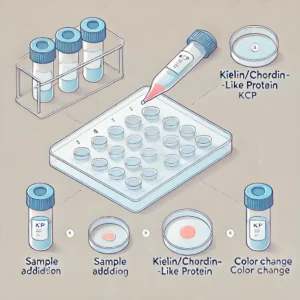
KCP ELISA kits are designed to detect KCP in various sample types, offering high specificity through antibody binding techniques. Validated in laboratories worldwide, including Johns Hopkins University and University of California, Berkeley, these kits are instrumental in evaluating KCP levels, which can indicate different disease states or developmental anomalies.
Mechanism of the KCP ELISA
The KCP ELISA assay uses antibodies to capture and quantify KCP in biological samples. Studies from Yale University highlight the precision of antibody binding in ELISA applications, emphasizing the importance of specificity and sensitivity.
- Capture and Detection Antibodies: The KCP ELISA method employs monoclonal antibodies for high specificity, reducing cross-reactivity. Antibody specificity research at University of Michigan has contributed to the accuracy of these assays, especially in clinical research.
- Quantitative Analysis: Accurate quantification allows researchers to measure KCP levels across samples, providing insight into disease states. Studies by the Centers for Disease Control and Prevention (CDC) underline the relevance of such precise measurements for disease monitoring.

Clinical and Research Applications of KCP ELISA
Due to its influence on key biological pathways, KCP is under investigation for several clinical applications. The Mayo Clinic and the National Kidney Foundation have both highlighted KCP’s role in renal disease and fibrosis, focusing on its potential as a therapeutic target.
- Kidney Disease: Elevated levels of KCP are associated with fibrotic kidney disease. The National Institute of Diabetes and Digestive and Kidney Diseases (NIDDK) supports research on KCP as a therapeutic target for renal conditions.
- Oncology: Research funded by the National Cancer Institute (NCI) demonstrates that KCP may affect tumor growth, providing avenues for new cancer treatments.
- Developmental Biology: KCP’s role in BMP signaling highlights its involvement in tissue development and organogenesis. Research by University of Wisconsin-Madison showcases the importance of KCP in skeletal development, while University of Pennsylvania focuses on its relevance in organ formation.
Research Techniques and KCP ELISA Analysis
Institutions like Emory University have standardized protocols for KCP ELISA, optimizing sensitivity and specificity for various applications. The Food and Drug Administration (FDA) emphasizes standardized testing for clinical applications, ensuring reliable and reproducible results across studies.
Advances in Sensitivity and Specificity in KCP ELISA
Research from University of California, San Francisco (UCSF) has advanced sensitivity levels in ELISA, allowing detection of lower protein concentrations and contributing to earlier disease detection. The National Institute of General Medical Sciences (NIGMS) has been at the forefront of supporting such advancements, enhancing KCP’s reliability as a biomarker.
Future Directions in KCP Research
Institutions like University of Chicago and the Department of Health and Human Services (HHS) are investigating KCP’s potential in treating degenerative diseases. As research progresses, KCP may prove pivotal in developing novel therapies for fibrotic, oncologic, and developmental diseases.
Conclusion
The KCP ELISA provides a powerful tool for measuring KCP levels in biological samples, enabling researchers to uncover insights into BMP signaling pathways and associated diseases. By facilitating accurate measurement, the KCP ELISA kit remains invaluable for scientific research and potential therapeutic development. Continued research supported by institutions such as the National Science Foundation (NSF) promises to expand our understanding of KCP’s role, particularly in kidney disease, cancer, and developmental biology.