
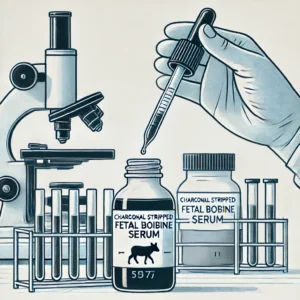
Charcoal Stripped Fetal Bovine Serum (CS-FBS) is an essential tool in cell culture studies requiring precise control over hormone levels. The serum is treated with activated charcoal to remove small molecules like steroids, hormones, and growth factors. This allows researchers to study hormone signaling, drug responses, and growth factor-dependent pathways in a controlled environment without interference from endogenous molecules. CS-FBS is widely used in hormone receptor studies, cancer research, and cell differentiation experiments.
What is Charcoal Stripped Fetal Bovine Serum?
Fetal Bovine Serum (FBS) is a crucial component of cell culture media, providing nutrients, hormones, and growth factors that promote cell growth and division. However, in studies focused on hormone-sensitive pathways, the hormones naturally present in FBS can interfere with experimental outcomes. Charcoal stripping removes these hormones while leaving behind larger proteins necessary for cell culture, enabling more controlled and reproducible experiments. Learn more about the properties of FBS and its stripping process at NIH.gov and NCBI.
How is Charcoal Stripped FBS Made?

The process of charcoal stripping involves treating the serum with activated charcoal, which adsorbs small molecules like:
- Steroid hormones (e.g., estrogen, testosterone)
- Thyroid hormones (e.g., thyroxine)
- Growth factors
Activated charcoal selectively removes these molecules without affecting larger proteins or essential nutrients. This method provides researchers with a hormone-free medium for controlled experimentation. For more details on the stripping process, visit FDA.gov and CDC.gov.
Applications of Charcoal Stripped FBS
- Hormone Receptor Studies
CS-FBS is indispensable in research involving hormone receptors, such as estrogen receptors (ER) and androgen receptors (AR). Researchers use it to eliminate endogenous hormones and then add back known concentrations to study hormone receptor activity. This is particularly useful in cancer research, especially for hormone-sensitive cancers like breast and prostate cancer. For detailed information on hormone receptor assays, visit NIH.gov and Stanford University. - Steroid Hormone Signaling
Steroid hormones, including estrogen and testosterone, are key regulators of cellular processes. Using CS-FBS enables researchers to study the specific effects of added hormones without interference from endogenous steroids. This application is critical in understanding the mechanisms of steroid hormone signaling pathways. Find more on this topic at Harvard University and NCBI. - Cell Differentiation Studies
In stem cell and tissue differentiation research, CS-FBS helps eliminate the influence of extraneous hormones and growth factors that could alter cell fate decisions. By controlling the environment, researchers can focus on the specific factors driving differentiation. Read more on cell differentiation techniques using CS-FBS at Johns Hopkins University and NIH.gov. - Drug Testing and Pharmacological Research
CS-FBS is used in pharmacology to study how cells respond to drugs without interference from serum-derived hormones or growth factors. This allows for clearer observations of the drug’s effects. For research into drug testing protocols, visit FDA.gov and University of California, Berkeley. - Endocrinology and Metabolic Research
Studies in endocrinology often require hormone-depleted media to analyze metabolic responses or hormone regulation. CS-FBS ensures that experimental outcomes are not influenced by extraneous hormones, providing more accurate results. More on endocrinology research using CS-FBS can be found at University of Michigan and CDC.gov.
Advantages of Using Charcoal Stripped FBS
- Controlled Experimental Conditions
CS-FBS provides researchers with the ability to precisely control hormone concentrations in their experiments, which is critical in hormone signaling research. By removing endogenous molecules, CS-FBS eliminates variability that could interfere with experimental results. Learn more about controlling experimental variables in cell culture at NCBI. - Reproducibility
The elimination of endogenous hormones and growth factors allows for greater reproducibility of results. This is essential for experiments where precise control over external variables is critical. Research on reproducibility in cell culture studies can be found at NIH.gov and Stanford University. - Flexibility for Hormone Addition
CS-FBS provides a hormone-depleted environment, enabling researchers to add specific hormones or growth factors back into the media at known concentrations. This flexibility is vital for studying dose-response relationships or hormone receptor activation. Detailed protocols for hormone addition using CS-FBS can be accessed at Johns Hopkins University and NCBI.
Limitations of Charcoal Stripped FBS
- Growth Factor Reduction
While CS-FBS removes unwanted hormones, it can also deplete necessary growth factors that promote cell growth. Some cell lines may require additional supplementation to maintain healthy growth. Researchers often add back growth factors such as epidermal growth factor (EGF) or fibroblast growth factor (FGF). Information on growth factor supplementation is available at Harvard University and NIH.gov. - Batch-to-Batch Variability
As with all serum products, CS-FBS may exhibit variability between batches, which can affect experimental consistency. It’s important to validate each new batch of CS-FBS with control experiments to ensure consistent results. More on minimizing variability in serum batches can be found at CDC.gov and FDA.gov.
Future Directions: Serum-Free and Defined Media
There is a growing interest in moving toward serum-free and chemically defined media to provide even more control over experimental conditions. While CS-FBS offers a hormone-free environment, defined media formulations provide complete control over every component in the culture system. These formulations eliminate the need for serum altogether and allow for highly reproducible and precise cell culture conditions. For information on serum-free media and advancements in defined culture systems, visit NIH.gov and NCBI.
Conclusion
Charcoal Stripped Fetal Bovine Serum (CS-FBS) is an essential tool for studies that require a hormone-free environment. It allows researchers to focus on specific pathways, such as hormone receptor signaling, drug responses, and cell differentiation, without the confounding influence of endogenous molecules. With its controlled and reproducible conditions, CS-FBS remains indispensable for cutting-edge research in endocrinology, cancer studies, and pharmacology. For further reading and detailed experimental protocols, visit trusted sources like NIH.gov, NCBI, and CDC.gov.