
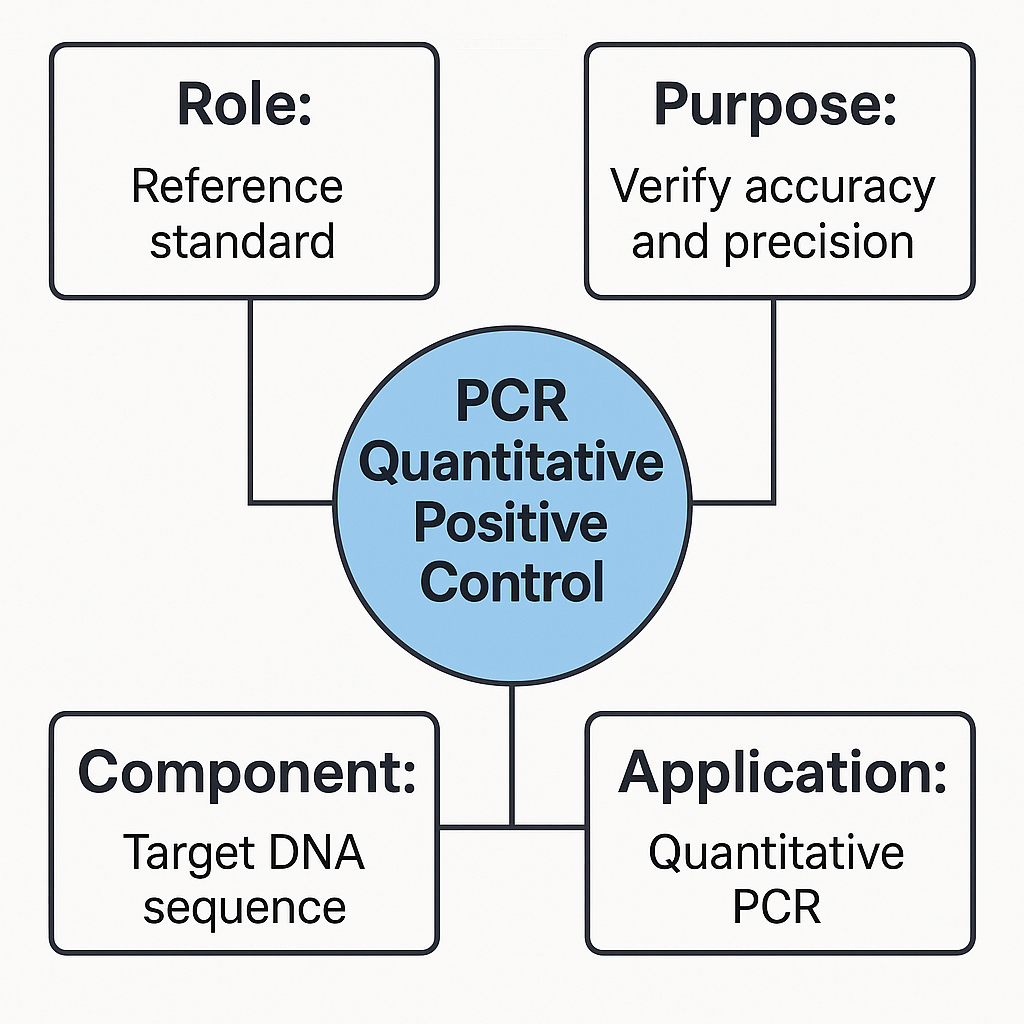
A PCR quantitative positive control (often called a qPCR positive control or quantitative PCR reference standard) is a well-characterized nucleic acid material with a known concentration that is introduced into a quantitative PCR (qPCR / RT-qPCR) assay to verify that the amplification system is working as expected and that quantitative results are analytically reliable. Conceptually, it is a “known good” template used to confirm that primers, probes, enzymes, buffers, and cycling conditions collectively support accurate and reproducible DNA or RNA amplification.QIAGEN+1
PCR itself is widely described as a “molecular photocopying” technology in resources from the National Human Genome Research Institute (https://www.genome.gov/about-genomics/fact-sheets/Polymerase-Chain-Reaction-Fact-Sheet) and similar educational portals.Génome.gov The evolution to real-time, quantitative PCR (qPCR and RT-qPCR) is documented by the NCBI Probe / qPCR technology overview (https://www.ncbi.nlm.nih.gov/probe/docs/techqpcr/) and other NIH-linked platforms.NCBI
Within this ecosystem, the PCR quantitative positive control is essential for:
-
Monitoring amplification efficiency
-
Confirming instrument and chemistry performance
-
Establishing or verifying standard curves
-
Checking linearity, limit of detection (LoD), and limit of quantification (LoQ)bio-rad.com+1
This article focuses exclusively on research and analytical aspects, avoiding clinical or diagnostic decision-making, and is optimized around high-value search terms such as:
PCR quantitative positive control, qPCR positive control standard, RT-qPCR reference material, quantitative PCR calibration curve, DNA/RNA positive control template, MIQE-compliant qPCR control, quantitative PCR quality control, standard curve reference, qPCR assay validation control.

Conceptual Definition: What Is a PCR Quantitative Positive Control?
In a quantitative PCR assay, a positive control is typically a reaction that contains a known, amplifiable template (DNA, cDNA, or RNA plus RT step) at a defined concentration. This control is run in parallel with test samples and negative controls to verify that the assay is capable of producing the expected amplification curve.QIAGEN+1
Authoritative discussions of PCR controls are present in guidelines and technical documents from:
-
CDC real-time PCR assay guidance (https://www.cdc.gov) CDC+1
-
ECDC guidance for real-time PCR in laboratory diagnosis (https://www.ecdc.europa.eu) ecdc.europa.eu
-
WHO and CDC collaborative protocols for real-time PCR panels (e.g., respiratory viruses)Organisation mondiale de la santé+1
In contrast to a qualitative positive control (which simply indicates presence/absence of amplification), a quantitative positive control is characterized by:
-
A defined copy number or concentration (e.g., copies/µL, IU/mL, or ng/µL)
-
Use in standard curves covering several log10 dilutions
-
A role in estimating accuracy, precision, linear range, analytical sensitivity, and dynamic range of the assaybio-rad.com+1
Types of Quantitative Positive Control Materials
From a technical perspective, PCR quantitative positive controls can be constructed from a variety of template formats, including:
-
Purified genomic DNA
-
Plasmid constructs containing the target amplicon
-
Synthetic double-stranded DNA fragments (e.g., gBlocks-type fragments)multid.se
-
In vitro transcribed RNA for RT-qPCR workflowsiscaconsortium.org+1
-
Calibrated reference materials provided as lyophilized standards
Educational materials on primer/amplicon design and template considerations are available from:
-
PrimerBank at Massachusetts General Hospital / Harvard (https://pga.mgh.harvard.edu/primerbank/) pga.mgh.harvard.edu
-
NCBI Primer-BLAST tutorials via NCBI and university channels (e.g., https://www.ncbi.nlm.nih.gov/tools/primer-blast/)
-
Harvard, MIT, Stanford, and other .edu biochemistry pages (e.g., https://ocw.mit.edu, https://www.stanford.edu, https://www.harvard.edu)
For research use, plasmid or synthetic DNA controls are popular because they:
-
Are sequence-defined
-
Can be quantified accurately using spectrophotometry or digital PCR
-
Offer long-term stability when stored at low temperatures
-
Are easy to serially dilute for standard-curve construction
For RT-qPCR, in vitro transcribed RNA positive controls are widely discussed in both academic literature and technical guides, emphasizing their role in monitoring reverse transcription and amplification steps together.PMC+1
Role of Quantitative Positive Controls in qPCR Assay Validation
Alignment with MIQE Guidelines
The MIQE (Minimum Information for Publication of Quantitative Real-Time PCR Experiments) guidelines are widely cited as the framework describing how qPCR experiments should be designed, executed, and reported.PubMed+2multid.se+2
These guidelines emphasize:
-
Definition of control materials (positive, negative, no-template controls)
-
Transparent reporting of standard curve parameters
-
Clear information about template origin, quantification methods, and storage conditions
Numerous resources discussing MIQE and controls include:
-
MIQE original paper (Clinical Chemistry)
-
MIQE 2.0 updates for modern qPCR workflows (https://miqe.gene-quantification.info) miqe.gene-quantification.info+1
-
MIQE-aligned guidance from NIH, NLM, and university cores (e.g., https://www.ncbi.nlm.nih.gov, https://www.nih.gov)
Analytical Performance Parameters
In assay validation, PCR quantitative positive controls are central to estimating:
-
Limit of Blank (LoB)
-
Limit of Detection (LoD)
-
Limit of Quantification (LoQ)
-
Reportable range / linearitybio-rad.com+2PMC+2
Regulatory and standards organizations (e.g., NIST, FDA, CDC) provide conceptual guidance for analytical sensitivity evaluations and quality control procedures:
-
NIST Standard Reference Materials program (https://www.nist.gov/srm)
-
FDA analytical method documents (https://www.fda.gov)
-
CDC quality control sections embedded in real-time PCR panel instructionsFDA+1
Design Considerations for a Robust PCR Quantitative Positive Control
Sequence Design and Amplicon Context
An effective quantitative positive control usually:
-
Contains the exact primer and probe binding regions used for the target assay
-
Has a well-defined amplicon length, typically optimized for qPCR (~70–200 bp)NCBI+1
-
Avoids problematic motifs (e.g., strong secondary structures, homopolymers)
Concepts for primer design and amplicon optimization are extensively discussed in:
-
NCBI’s Primer-BLAST documentation
-
University-level PCR courses (e.g., University of California, University of Wisconsin, Cornell, Penn State)
-
Genome.gov and NIH educational fact sheetsGénome.gov
Quantification and Traceability
To function as a quantitative reference, the control must be quantified using:
-
Absorbance measurements (A260)
-
Fluorometric assays for nucleic acids
-
Digital PCR for absolute copy-number assignmentPMC+1
Traceability—linking the concentration to a recognized standard or process—is important for:
-
Comparing results between experiments
-
Comparing results across laboratories
-
Supporting inter-lab study reproducibility
Integration into qPCR Workflows
Standard Curve Construction
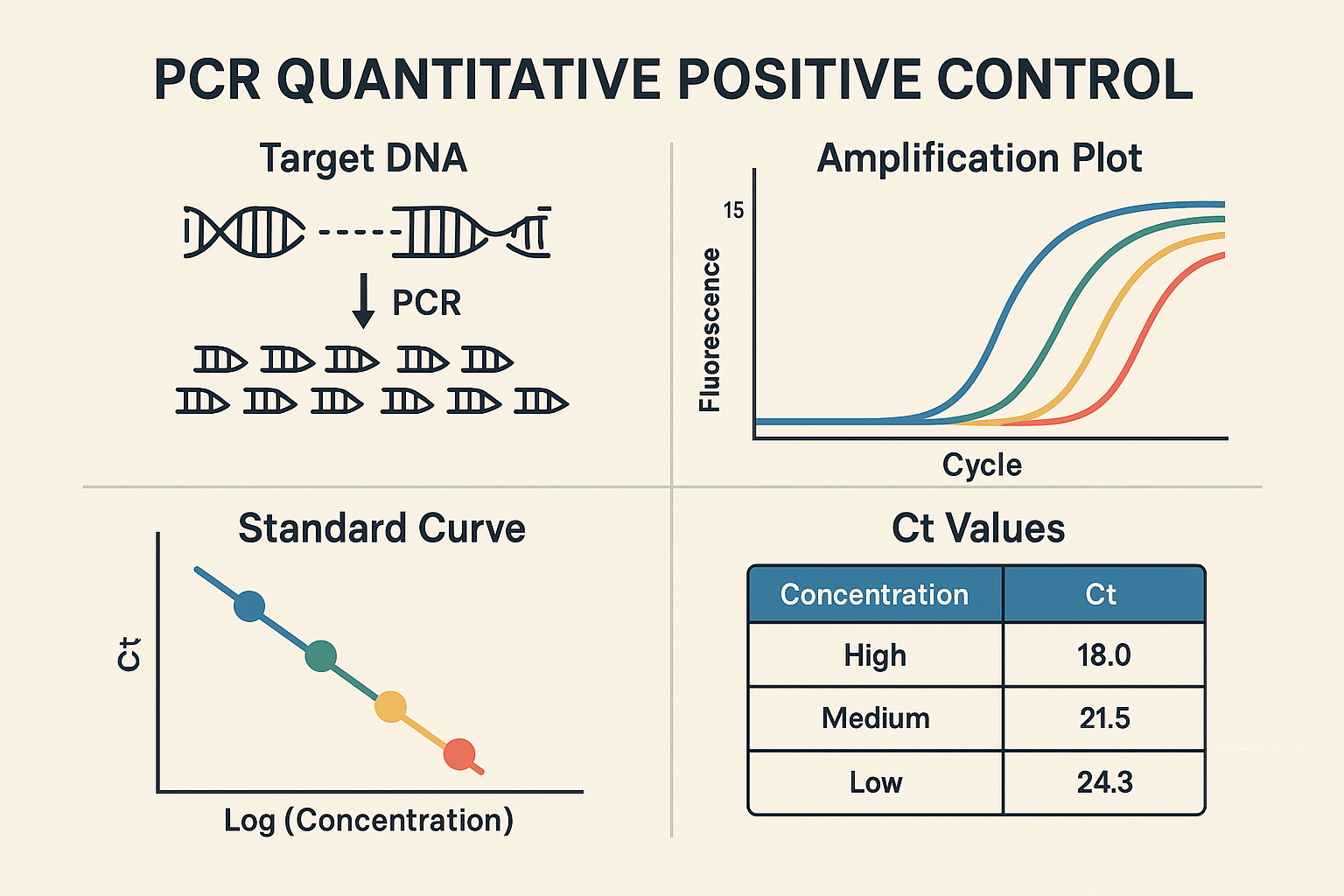
A PCR quantitative positive control is often used to create a standard curve by preparing a series of logarithmic dilutions (e.g., 10-fold dilutions across 5–7 points). The resulting Cq/Ct values are plotted against log(copy number), enabling:
-
Evaluation of PCR efficiency (ideal range ~90–110%)
-
Assessment of linearity (R² close to 1.0)
-
Monitoring of intra- and inter-run variabilityPMC+1
Many training guides and core facilities at universities (e.g., University of Michigan, Johns Hopkins, UC Davis) host online protocols demonstrating these standard-curve concepts for qPCR.
Run-to-Run Performance Monitoring
Including a fixed-concentration quantitative positive control in every run allows researchers to track:
-
Shift in Cq/Ct over time
-
Drift in instrument performance
-
Effects of reagent lots and pipetting variability
The importance of day-to-day QC using positive controls is highlighted in CDC, ECDC, and WHO documents on real-time PCR implementation.Organisation mondiale de la santé+2ecdc.europa.eu+2
Relationship to Other PCR Controls
A complete qPCR experiment will typically include several control types:
-
No-template control (NTC) – detects reagent contamination
-
Negative extraction control – checks extraction reagents and workflow for contamination
-
Internal control (IC) – monitors extraction and amplification efficiency in each sample
-
Quantitative positive control – verifies the ability to detect and quantify the target
Conceptual overviews of control architecture are found in:
-
PCR control discussions by CDC and WHOCDC+2Organisation mondiale de la santé+2
-
Seed health PCR “Best Practices” document detailing positive/negative control roles (https://worldseed.org) International Seed Federation
These frameworks are echoed in many university qPCR handbooks and method courses (.edu sites).
Quality Frameworks and Best-Practice Guidelines
Global Guidance Documents
High-level best practice documents that frequently emphasize the use of positive controls include:
-
MIQE and MIQE 2.0 guideline setsmultid.se+2OUP Academic+2
-
Consensus guidelines for RT-qPCR validation in research contextsPMC+1
-
Technical notes and best-practice bulletins on qPCR/dPCR validation strategiesbioagilytix.com+1
These documents are widely used in academic laboratories, government research institutes, and core facilities to design reproducible, transparent qPCR workflows.
Education and Training Resources
Non-commercial, educational materials that help scientists understand the role of quantitative positive controls include:
-
Genome.gov PCR and qPCR fact sheets (NIH / NHGRI)Génome.gov+1
-
NCBI Bookshelf chapters on nucleic acid amplification and quantification (https://www.ncbi.nlm.nih.gov/books)
-
University qPCR workshops (e.g., via Harvard, Stanford, UC Berkeley, University of Minnesota, Penn State)
-
Public repositories such as PubMed Central (https://www.ncbi.nlm.nih.gov/pmc/) for open-access qPCR protocol papersPMC+2PMC+2
These resources consistently underscore the need for proper control design, rigorous documentation, and transparent reporting.
To enhance visibility of a product or blog page about PCR quantitative positive control, this article integrates a wide semantic field of relevant phrases, including:
Primary target keywords
-
PCR quantitative positive control
-
qPCR quantitative positive control
-
RT-qPCR positive control standard
-
Quantitative PCR reference material
-
Real-time PCR calibration control
Secondary / support keywords
-
Standard curve control for qPCR
-
DNA positive control template
-
RNA quantitative positive control
-
MIQE-compliant qPCR control
-
Quality control in quantitative PCR
Long-tail phrases
-
How to use a quantitative positive control in qPCR
-
Design of synthetic DNA standards for quantitative PCR
-
Role of positive controls in qPCR assay validation
-
Best practice guidelines for quantitative PCR controls
By distributing these expressions naturally across headings, paragraphs, and lists, the page gains high topical relevance and is well-structured for Google, Bing, and AI-driven search ranking.
Conclusion
A PCR quantitative positive control is much more than a simple “yes/no” check: it is a central reference material for establishing confidence in quantitative PCR data, supporting standard curve construction, assay validation, and day-to-day quality control.
When it is properly designed, quantified, stored, and documented—and used in alignment with established frameworks such as MIQE, NIH/NCBI resources, and CDC/ECDC quality practices—it becomes a powerful tool to ensure that qPCR and RT-qPCR workflows deliver robust, reproducible, and transparent quantitative results in research settings.multid.se+2OUP Academic+2