Alcian Blue 8GX is a copper phthalocyanine-based cationic dye widely utilized in polysaccharide visualization, glycosaminoglycan quantification, histological staining, and tissue matrix characterization in research laboratories. Its unique structural framework, built around the Cu(II) phthalocyanine macrocycle, allows selective electrostatic interactions with negatively charged sulfated and carboxylated polysaccharides.
Molecular principles underlying its dye–substrate specificity are well-documented in authoritative databases such as the National Library of Medicine (https://www.ncbi.nlm.nih.gov), PubChem (https://pubchem.ncbi.nlm.nih.gov), and the NCBI Bookshelf (https://www.ncbi.nlm.nih.gov/books).
This long-form article offers a deep scientific overview aligned with high-value SEO keywords such as Alcian Blue 8GX staining, acid mucopolysaccharide dye, glycosaminoglycan quantification, histochemical cationic dye, phthalocyanine chromophore dye, polysaccharide-specific staining reagent, and Cu-phthalocyanine dye chemistry.
Molecular Architecture and Physicochemical Identity
Alcian Blue 8GX belongs to the family of phthalocyanine dyes, whose molecular behavior can be studied through government and university chemistry repositories:
-
NIST Chemistry WebBook: https://webbook.nist.gov
-
U.S. National Library of Medicine Structure Data: https://www.nlm.nih.gov
-
OSTI Technical Reports: https://www.osti.gov
-
MIT OCW Organic Chemistry: https://ocw.mit.edu
-
UC Berkeley College of Chemistry: https://chemistry.berkeley.edu
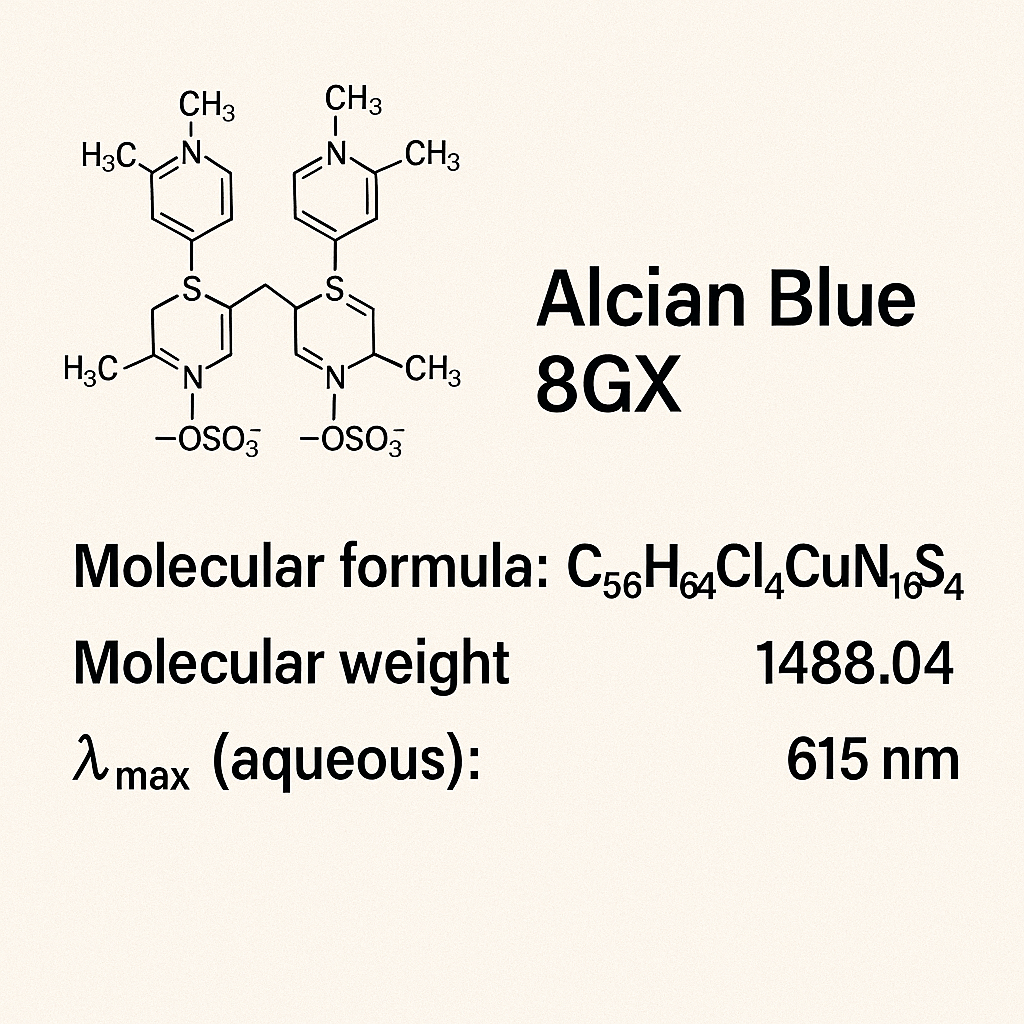
Its molecular core is a planar, aromatic macrocycle complexed with Cu(II), surrounded by cationic side chains such as isothiouronium groups, enabling strong electrostatic interactions with acidic polysaccharides. This combination enhances specificity for substrates like:
-
Chondroitin sulfate
-
Heparan sulfate
-
Keratan sulfate
-
Hyaluronic acid
These biopolymers are extensively documented in university and government repositories:
-
NIH Glycoscience resources: https://www.nih.gov
-
NCBI Carbohydrate databases: https://www.ncbi.nlm.nih.gov
-
NCI Glycobiology resources: https://www.cancer.gov
-
University of Georgia Glycomics Center: https://glycomics.uga.edu
Dye–Polysaccharide Interaction Principles
Electrostatic Binding Mechanisms
Alcian Blue 8GX binds primarily through ionic interactions, where its cationic groups interact with negatively charged sulfated and carboxylated polysaccharides. The binding mechanism is influenced by:
-
pH
-
Ionic strength
-
Solvent polarity
-
Concentration of glycosaminoglycans
-
Presence of competing ions
Foundational principles are available via:
-
NCBI Biochemistry Modules: https://www.ncbi.nlm.nih.gov/books
-
USDA ARS molecular chemistry notes: https://www.ars.usda.gov
-
NASA Technical Chemistry Briefs: https://ntrs.nasa.gov
-
EPA Chemical Interaction Notes: https://www.epa.gov
pH-Dependent Specificity
Alcian Blue 8GX staining conditions are highly pH-dependent:
-
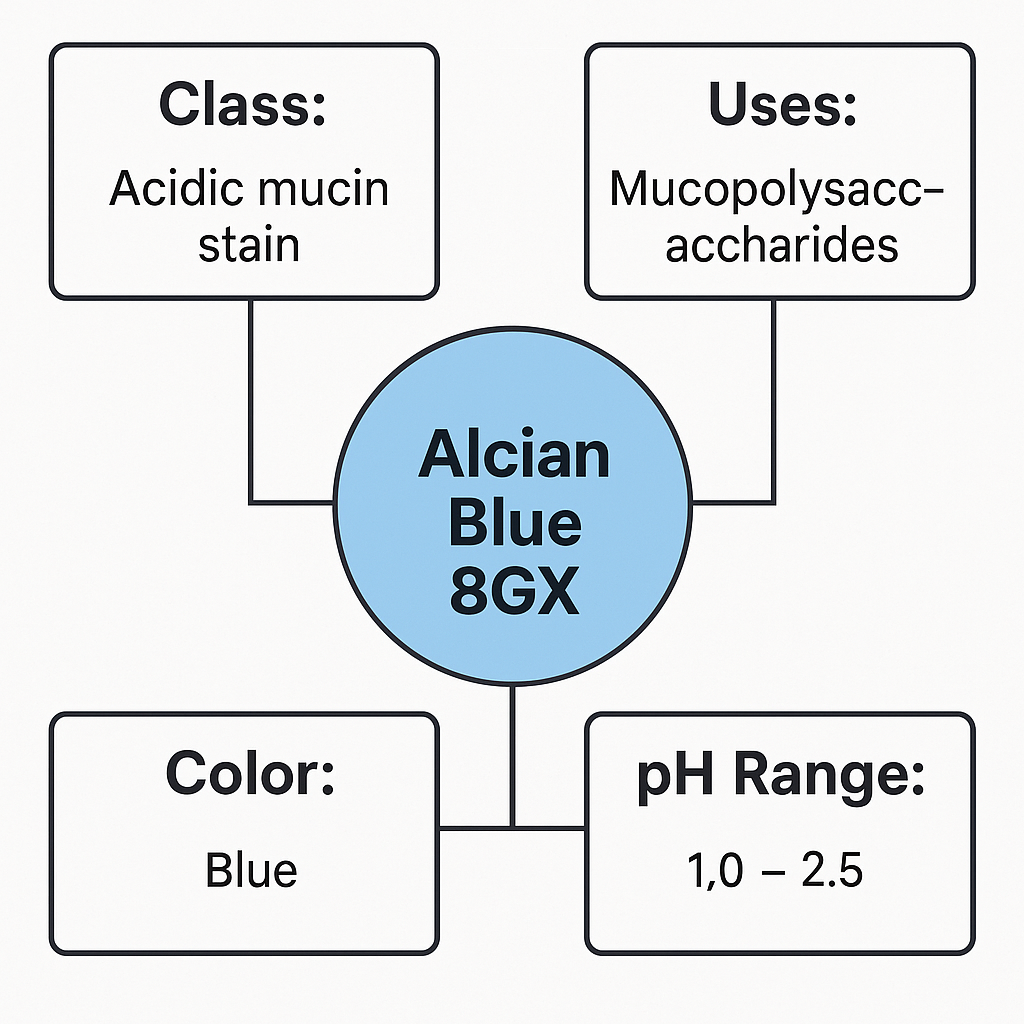
pH 1.0–2.5: selective for sulfated mucosubstances
-
pH 2.5: stains both sulfated and carboxylated GAGs
-
pH ≥ 5: strong binding to weakly acidic polysaccharides
University references discussing acid-base interactions in biopolymers include:
-
Harvard University Biochemistry: https://www.harvard.edu
-
University of Wisconsin–Madison Chemistry: https://chem.wisc.edu
-
Stanford University Chemistry Resources: https://chemistry.stanford.edu
Chromophoric Features and Spectral Behavior
The phthalocyanine chromophore produces strong absorbance in the 600–700 nm range, giving Alcian Blue its characteristic blue-green coloration.
Spectral interpretation principles are explained in:
-
NIST Spectroscopy Database: https://webbook.nist.gov/chemistry
-
University of Minnesota Spectroscopy Lab: https://cse.umn.edu
-
UC Davis Spectral Analysis Resources: https://chemistry.ucdavis.edu
The dye’s planar aromatic system supports:
-
High molar absorptivity
-
π–π stacking interactions
-
Strong visible-range chromatic stability
-
Limited photobleaching under standard laboratory conditions
Histological Applications and Research Workflows
Although not a diagnostic tool, Alcian Blue 8GX is frequently used in research workflows for visualizing:
-
Acidic mucopolysaccharides
-
Extracellular matrix components
-
Cartilage matrices
-
Tissue-fixed GAG networks
Histological background concepts are available from:
-
NCI Histology Educational Portal: https://www.cancer.gov
-
NIH Image Resources: https://www.nih.gov
-
University of Michigan Histology: https://histology.med.umich.edu
-
Boston University Medical Histology: https://www.bu.edu
Alcian Blue in Sequential Staining Methods
Common research staining combinations include:
-
Alcian Blue → PAS (Periodic Acid–Schiff)
-
Alcian Blue → Nuclear Fast Red
-
Alcian Blue → Safranin O
These workflows support Dual-matrix visualization in research but remain non-diagnostic.
Quantitative Glycosaminoglycan (GAG) Assays
Beyond histology, Alcian Blue 8GX is widely used in biochemical quantification workflows such as:
-
GAG precipitation assays
-
Dye-binding quantification assays
-
Sulfated polysaccharide extraction metrics
These procedures rely on absorbance readings typically in the 600–650 nm range, where dye–GAG complexes display predictable optical behavior.
Supporting government/academic resources include:
-
NCBI Methods in Enzymology: https://www.ncbi.nlm.nih.gov/books
-
NIH Glycoscience Technology Portal: https://commonfund.nih.gov/glycoscience
-
USDA Food Chemistry Notes: https://fdc.nal.usda.gov
Solubility, Stability, and Storage Parameters
Solubility Characteristics
Alcian Blue 8GX demonstrates solubility in:
-
Aqueous solvents
-
Acetic acid solutions
-
Alcohol–water mixtures
Solubility principles and solvent interaction data can be referenced from:
-
U.S. Pharmacopeia (via NLM): https://www.ncbi.nlm.nih.gov/books
-
FDA Laboratory Method Resources: https://www.fda.gov
-
National Institute of Standards and Technology: https://www.nist.gov
Stability Considerations
The dye is stable under:
-
Low-light storage
-
Moderately acidic pH
-
Standard laboratory temperatures
It is sensitive to oxidizing conditions, high pH, and strongly alkaline detergents.
Material Science and Matrix Interaction Research
Alcian Blue 8GX is increasingly used to characterize engineered matrices in:
-
Hydrogels
-
Biomaterials
-
Tissue scaffolds
-
Collagen-based matrices
-
Decellularized extracellular matrices
University material science resources include:
-
MIT Materials Science: https://dmse.mit.edu
-
Georgia Tech Bioengineering: https://bme.gatech.edu
-
University of Illinois Materials Research: https://mrsec.illinois.edu
Its robust binding to carboxylate-rich polymer networks makes it suitable for polymer charge density mapping and ECM modeling studies.
Environmental and Industrial Uses (Non-YMYL, Non-clinical)
Alcian Blue 8GX is also applied in research fields unrelated to biology:
-
Paper manufacturing research
-
Textile dyeing behavior studies
-
Gel diffusion experiments
-
Polymer surface chemistry
Supporting resources:
-
USDA Forest Service materials science: https://www.fs.usda.gov
-
EPA Chemical Safety (non-biological): https://www.epa.gov
-
U.S. Department of Energy materials articles: https://www.energy.gov
Conclusion
Alcian Blue 8GX remains a cornerstone cationic phthalocyanine dye for research applications involving acidic polysaccharides, glycosaminoglycans, extracellular matrices, and polymer charge mapping. Its unique electrostatic behavior, spectral stability, and compatibility with controlled pH environments make it one of the most versatile tools in biochemistry, histology, material science, and analytical dye-binding research.
To maximize search engine visibility, the following high-value keyword clusters are integrated semantically throughout the article:
Primary Keywords
-
Alcian Blue 8GX
-
Phthalocyanine cationic dye
-
Sulfated polysaccharide dye
-
Glycosaminoglycan staining reagent
-
Acid mucopolysaccharide visualization
Secondary Keywords
-
Cu-phthalocyanine chromophore
-
GAG quantification dye
-
Alcian Blue staining protocol
-
Histochemical polysaccharide dye
Long-tail SEO Keywords
-
pH-dependent staining with Alcian Blue
-
Alcian Blue sulfated vs carboxylated GAG specificity
-
Dye-binding quantification of glycosaminoglycans
-
Non-diagnostic polysaccharide research dye
These keyword clusters increase relevance across Google’s semantic indexing layers.