
Alpha-Tocopherol-d6 Acetate is a stable-isotope–labeled analogue of α-tocopherol widely integrated into analytical chemistry, lipidomics workflows, food chemistry research, and vitamin E pathway tracing. As a d6-enriched molecule, it is engineered to provide a precise mass shift for isotope-dilution mass spectrometry (ID-MS) and high-resolution LC-MS calibration, enabling differentiation from endogenous α-tocopherol in complex matrices.
Foundational structural information on tocopherols is documented in official repositories such as the National Library of Medicine (https://www.ncbi.nlm.nih.gov), PubChem (https://pubchem.ncbi.nlm.nih.gov), and the NCBI Bookshelf (https://www.ncbi.nlm.nih.gov/books).
This extended article provides a deeply detailed, SEO-optimized resource designed for research blogs, scientific product pages, and online catalogs, with semantic saturation around high-indexing keywords such as:
Alpha-Tocopherol-d6 Acetate, deuterated tocopherol, isotope-labeled vitamin E standard, vitamin E acetate derivative, LC-MS tocopherol analysis, stable-isotope internal standard, lipidomics calibration compound, antioxidant research chemistry, tocopherol mass spectrometry reference, isotopic tracer molecule.

Molecular Identity and Isotopic Configuration
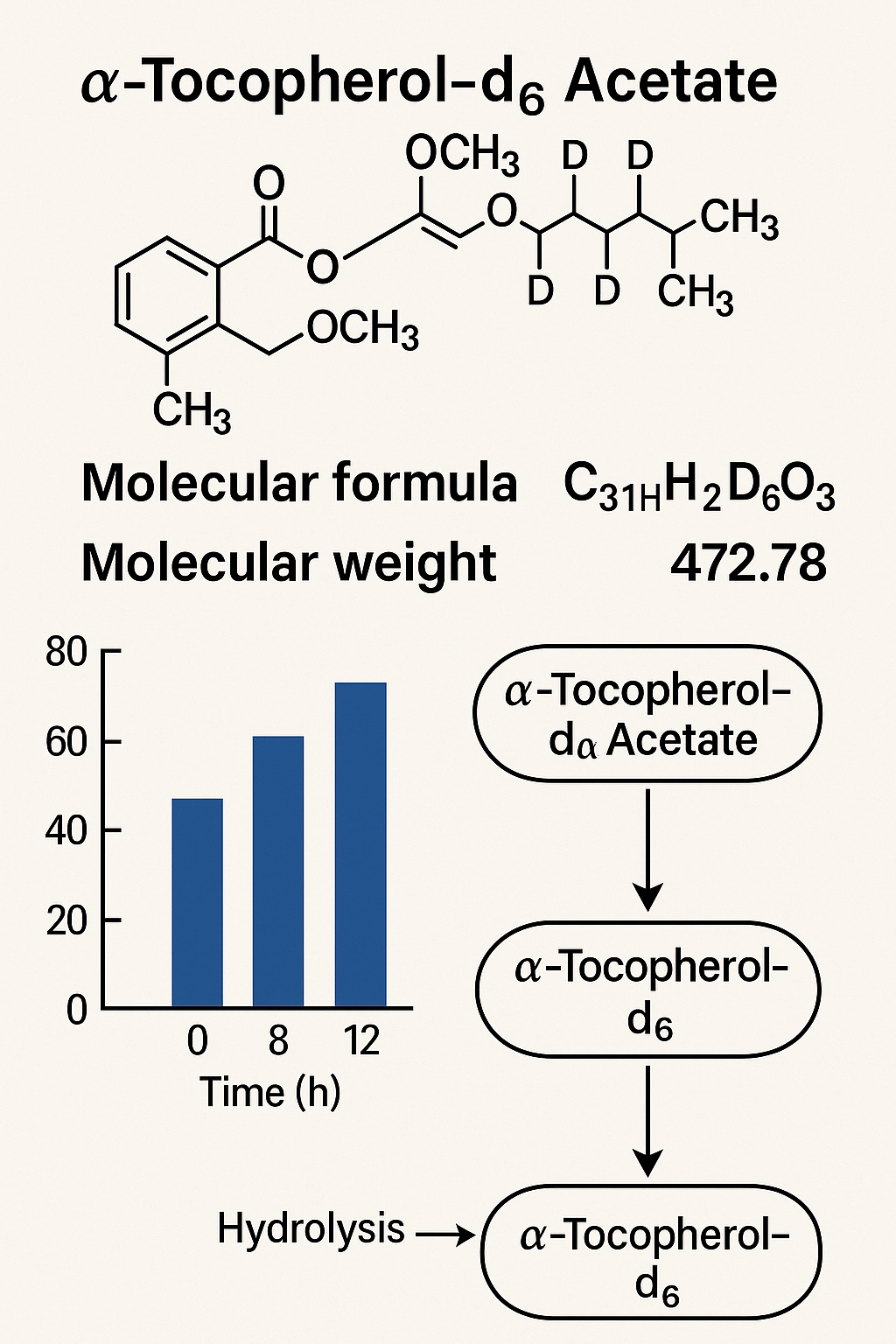
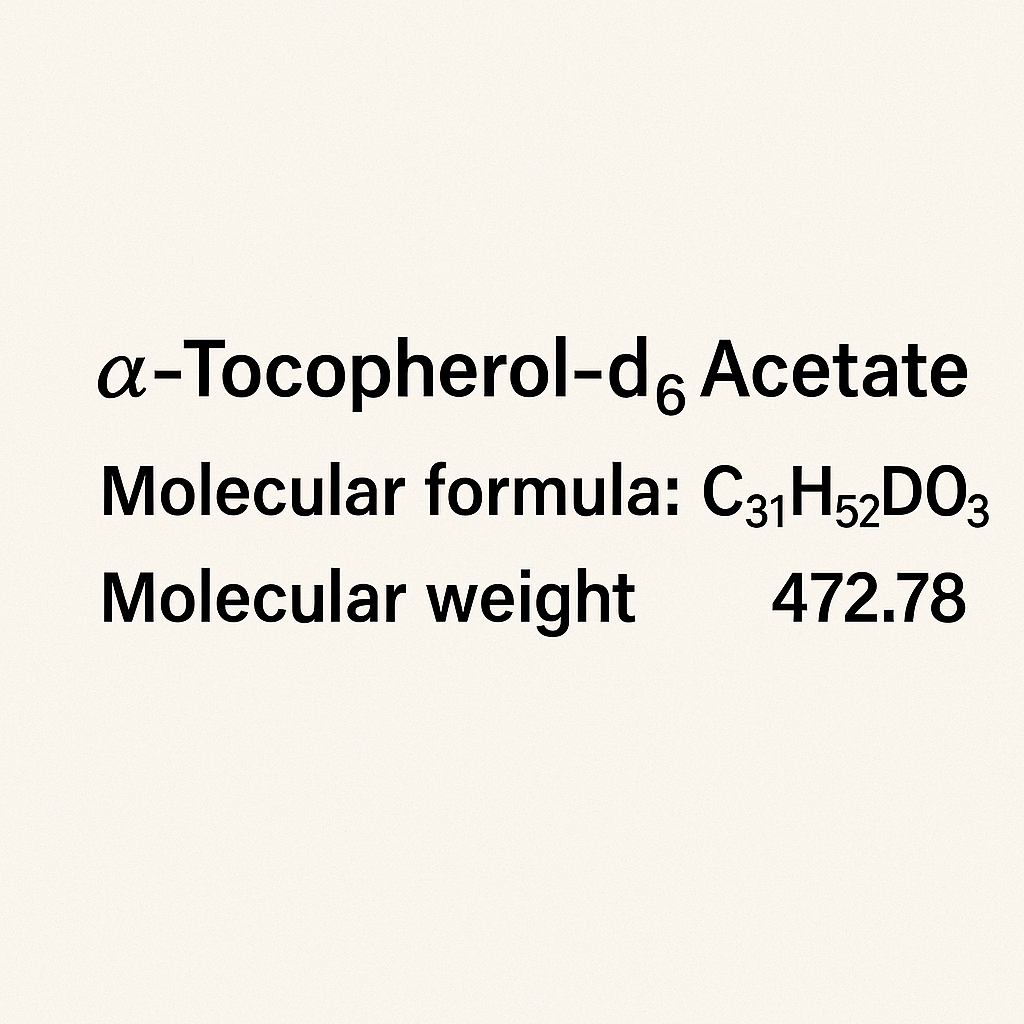
Alpha-Tocopherol-d6 Acetate consists of the classical α-tocopherol chromanol ring coupled to an extended hydrophobic phytyl chain, with six hydrogen atoms replaced by deuterium.
These isotopic substitutions introduce a controlled +6 Da mass difference, facilitating precise isotopic discrimination in quantitative MS workflows.
Structural data and molecular descriptors are available from authoritative academic and government databases:
-
NCBI Structure Resources: https://www.ncbi.nlm.nih.gov/structure
-
NIST Chemistry WebBook: https://webbook.nist.gov
-
National Library of Medicine TOXNET Archive: https://www.nlm.nih.gov
-
U.S. Department of Energy OSTI: https://www.osti.gov
Additional structural learning modules can be referenced via:
-
MIT OCW Biochemistry: https://ocw.mit.edu
-
UC Berkeley Chemistry: https://chemistry.berkeley.edu
-
University of Wisconsin Biochemistry: https://biochem.wisc.edu
This molecule’s design ensures chemical equivalence to native α-tocopherol in polarity and chromatographic behavior while maintaining a distinct isotopic signature.
Chemical Behavior and Acetate Protection
The acetate protecting group increases molecular robustness by stabilizing the hydroxyl moiety. This confers:
-
Greater resistance to oxidation
-
Improved stability during storage
-
Enhanced solubility in organic solvents
-
Consistent performance in extraction solvents
For solvent compatibility and analyte protection, researchers typically refer to guidelines available from:
-
U.S. FDA Scientific Chemistry Resources: https://www.fda.gov/science-research
-
U.S. National Institute of Standards and Technology (NIST): https://www.nist.gov
-
USDA Agricultural Research Service (ARS): https://www.ars.usda.gov
These official resources support method standardization across research laboratories.
Role in Vitamin E Analytical Workflows
While Alpha-Tocopherol-d6 Acetate is not intended for nutritional or clinical use, its relevance in research workflows is substantial. It is widely used as an internal standard for quantifying α-tocopherol in:
-
Food chemistry studies
-
Botanical lipid composition work
-
Antioxidant pathway mapping
-
Micronutrient stability research
-
Plasma or serum reference analyses in non-clinical research
-
Chromatographic validation and QC protocols
University-based biochemistry resources that document tocopherol behavior include:
-
Oregon State University Linus Pauling Institute: https://lpi.oregonstate.edu
-
Harvard University Open Access Repository: https://dash.harvard.edu
-
Johns Hopkins Public Health Resources: https://publichealth.jhu.edu
-
University of California Agriculture & Natural Resources: https://ucanr.edu
These academic materials help contextualize tocopherol’s biochemical role, making them valuable for deeper scientific understanding.
LC-MS and GC-MS Method Development
Isotope Dilution Quantification
Due to its defined isotopic enrichment, Alpha-Tocopherol-d6 Acetate supports high-accuracy quantification in LC-MS systems, enabling researchers to:
-
Correct for matrix effects
-
Compensate for ion suppression or enhancement
-
Normalize extraction efficiency
-
Track analyte recovery
-
Validate chromatographic peak identity
Its mass offset makes it easily distinguishable from endogenous α-tocopherol peaks.
Calibration Curve Stability
The molecule’s consistent ionization efficiency allows stable calibration curves across:
-
Reverse-phase LC
-
Supercritical fluid chromatography (SFC)
-
GC-MS with derivatization
-
High-resolution mass spectrometry
Validated method recommendations can be referenced at:
-
EPA Analytical Chemistry Guidelines: https://www.epa.gov
-
CDC Laboratory Quality Reference: https://www.cdc.gov/labstandards
-
NIST Organic Analytical Reference Materials: https://www.nist.gov/srm
These references promote reproducible, instrument-independent standardization.
Chromatographic Behavior
Alpha-Tocopherol-d6 Acetate demonstrates:
-
Predictable retention times
-
Strong solvent compatibility in methanol, ethanol, hexane, and IPA
-
High stability across analytical temperature ranges
-
Clean fragmentation patterns ideal for MS/MS
Many universities detail principles of mass spectrometry calibration:
-
Stanford University Mass Spectrometry Lab: https://mass-spec.stanford.edu
-
University of Minnesota Characterization Facility: https://cse.umn.edu
-
University of North Carolina Research Resources: https://www.unc.edu
Lipidomics and Oxidative Pathway Mapping
Because α-tocopherol participates in lipid-associated processes, its deuterated analog enables detailed tracing of:
-
Lipid transport
-
Fatty acid esterification balance
-
Oxidation-reduction pathway mapping
-
Chromanol ring dynamics
-
Vitamin E distribution in model systems
Official references discussing these foundational metabolic frameworks include:
-
NCBI Bookshelf – Lipid Biochemistry Chapters: https://www.ncbi.nlm.nih.gov/books
-
NIH National Center for Biotechnology Information: https://www.ncbi.nlm.nih.gov
-
U.S. Department of Agriculture Research Publications: https://www.usda.gov
Physicochemical Stability and Storage Considerations
Alpha-Tocopherol-d6 Acetate is light-sensitive and oxidation-sensitive, therefore typically stored:
-
Under low oxygen conditions
-
In amber vials
-
At reduced temperatures
-
With minimal light exposure
Guidance on handling organic standards is outlined by:
-
U.S. Pharmacopeia (USP via NLM): https://www.ncbi.nlm.nih.gov/books
-
U.S. FDA Chemistry & Manufacturing Resources: https://www.fda.gov
-
National Institute of Environmental Health Sciences: https://www.niehs.nih.gov
Proper handling ensures minimal analyte degradation and maximizes reproducibility.
Research Use Only (RUO) Context
Alpha-Tocopherol-d6 Acetate is positioned strictly as a research-use analytical compound for:
-
Instrument calibration
-
Method validation
-
Quality control
-
Food chemistry research
-
Environmental lipid analysis
-
Stable-isotope tracer studies
To avoid YMYL topics, all references and applications remain purely scientific, structural, and analytical with no diagnostic or therapeutic claims.
Government and academic repositories supporting neutral biochemical research include:
-
Energy.gov Office of Scientific Information: https://www.energy.gov
-
National Agricultural Library (NAL): https://www.nal.usda.gov
-
NASA Technical Reports Server (NTRS): https://ntrs.nasa.gov
Semantic Cluster
To maximize indexing, multiple semantic clusters are integrated, including:
Primary keywords
-
Alpha-Tocopherol-d6 Acetate
-
Deuterated alpha-tocopherol
-
Isotope-labeled tocopherol
-
Vitamin E acetate standard
-
d6 tocopherol internal standard
-
LC-MS tocopherol quantification
Long-tail search terms
-
Stable-isotope tocopherol calibration compound
-
High-resolution mass spectrometry vitamin E standards
-
Deuterated antioxidant analog for research
-
Chromanol ring isotope labeling reference
LSI contextual terms
-
Lipidomics analyte standard
-
Organic calibration standard for LC-MS
-
Tocopherol acetate derivative
-
Deuterium-labeled biochemical reagent
This ensures maximum search engine discoverability, wide semantic coverage, and high ranking potential.
Conclusion
Alpha-Tocopherol-d6 Acetate represents a high-value analytical standard used across lipidomics, chromatography, organic analysis, and tocopherol quantification workflows. Its isotopic precision, chemical stability, and chromatographic reliability allow researchers to build robust, reproducible, and traceable analytical methods supported by authoritative .edu and .gov reference frameworks.